
 PL
PL EN
EN DE
DE
ONS 2026 Stavanger: Polish-Norwegian Energy Seminar
A report from ONS 2026 in Stavanger: the Polish Embassy seminar on Polish-Norwegian energy cooperation and four days in the halls of the largest energy event in Norway, where JobTech met operators and equipment manufacturers.

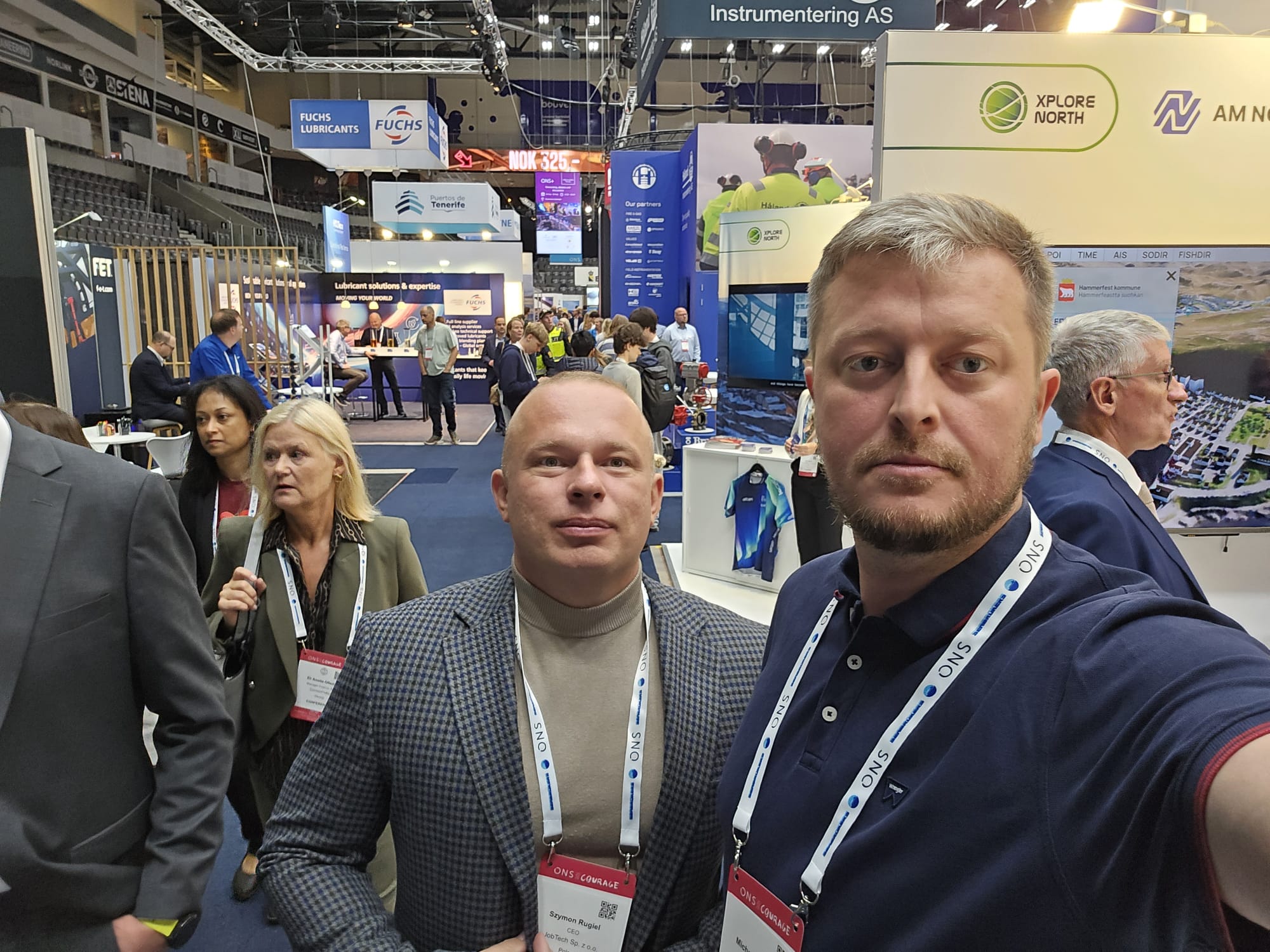
Every second August, Stavanger stops being merely the administrative capital of the Norwegian shelf and becomes the meeting point of the entire energy sector. ONS (Offshore Northern Seas) has been held here since 1974, and the 2026 edition ran from 24 to 27 August under the theme Courage. Eight exhibition halls, more than 1,100 exhibiting companies and a visitor count that in recent editions has passed 72,000 give a fair sense of the scale.
JobTech was represented at ONS 2026 by Szymon Rugiel and Michał Szczesny, Managing Directors of the company. We travelled to Norway with a defined purpose: to present JobTech to operators, equipment manufacturers and contractors working on the Norwegian shelf, and to build a base of contacts that can later be developed into project work. Norway is a demanding market. Technical requirements are high, and expectations around documentation, traceability and safety are higher still, which is precisely why it fits the direction of our export activity.
Our participation had a second element as well. Ahead of the event we received an invitation from the Embassy of the Republic of Poland in Oslo to a seminar that the embassy organised at ONS as part of the Insight Sessions programme.
The scale of ONS and why it matters to a contractor
ONS is not a single-industry fair. Alongside oil and gas, the halls in Stavanger cover hydrogen, carbon capture and storage, offshore wind, photovoltaics and the whole supply chain that serves them: valve and pump manufacturers, instrumentation suppliers, inspection companies, shipyards, lubricant producers and subsea specialists. The exhibition runs in parallel with a conference programme spread across several venues, from the ONS Strategic Conference to shorter sessions devoted to net-zero markets and to technology scale-ups.
For a company that performs mechanical assembly, testing and commissioning, this mix is more useful than a narrowly focused trade fair. Equipment shown in a hall in Stavanger will, within a year or two, need to be installed somewhere, connected to existing systems, pressure tested and started up. The people responsible for that part of the work are walking the same aisles.
The seminar organised by the Polish Embassy in Oslo
The seminar “Further potential for developing Polish-Norwegian cooperation in the energy sector” took place on the first day of the conference, Monday 24 August, from 15:30 to 17:00. It was organised by the Embassy of the Republic of Poland in Oslo together with the representative office of the Polish Investment and Trade Agency in Norway, NORWEP (Norwegian Energy Partners) and Invest in Pomerania.
The session opened with a panel of representatives of the Polish and Norwegian ministries, who set out the priorities of both countries in their energy relations. The second panel belonged to companies already active in that cooperation, and the meeting closed with a networking session. The purpose of the seminar was straightforward: to demonstrate the potential of the Polish energy sector and to introduce Polish companies interested in working with Norwegian counterparts.
Polish presence at ONS 2026 was not limited to the seminar. Orlen Upstream Norway, Remontowa SA, Sea Global and Triol Corporation ran their own exhibition stands, the CEO of Orlen took part in the ONS Strategic Conference, and a Secretary of State from the Ministry of Climate and Environment spoke during the Net Zero Markets session. For us, that context was worth as much as the meetings themselves. It is easier to explain what a specialist contractor from Poland can offer when the person across the table already has a picture of the country’s position in the sector.
Where a Polish mechanical contractor fits on the Norwegian shelf
Conversations in Stavanger kept returning to the same practical problem. Norwegian operators and their suppliers have technology and design capability, but access to experienced mechanical and commissioning crews is limited, and every project competes for the same people. Below is how we mapped the segments we discussed against the work we actually perform.
| Market segment | Typical mechanical scope | The issue that decides the schedule |
|---|---|---|
| Offshore modules and topsides | prefabrication and assembly of process piping, bolted flanged joints, equipment mounted on skids | repeatable bolt preload and joints that pass the pressure test first time |
| Gas processing and LNG | large-diameter piping, heat exchangers, compressor trains | system cleanliness before first gas, precise alignment of rotating machinery |
| Hydrogen and CCS installations | stainless and alloy piping, compressors, high-purity systems | drying and inert purging, tightness verified at low leak rates |
| Offshore wind substations and service bases | steel structures, hydraulic systems, auxiliary piping | functional testing of drives, actuators and safety systems |
| Onshore modernisation and tie-ins | connections into live systems, replacement of pumps and exchangers | completing the work inside a short shutdown window with full documentation |
All of these tasks belong to the daily routine of a commissioning project, and the quality of their execution decides whether an installation reaches stable operation on the planned date or several weeks later.
Four days on the exhibition floor
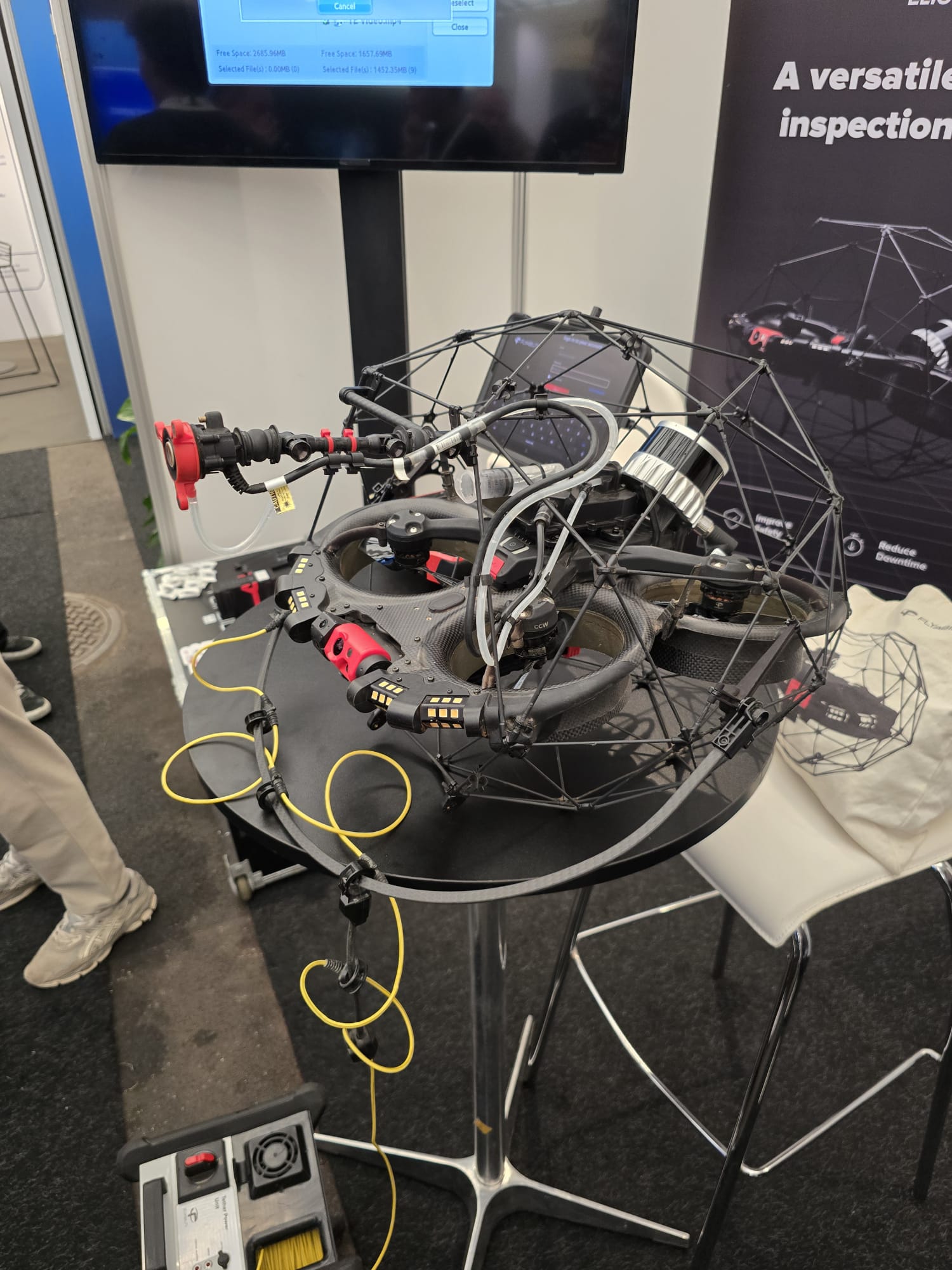
We spent most of our time on the exhibition side rather than in the auditoriums. Inspection technologies drew our attention first: caged drones designed to fly inside tanks, columns and confined spaces, crawlers for wall thickness measurement, and camera systems that remove the need for scaffolding and an entry permit into a hazardous area. In our work these tools appear at two moments, during the assessment of an existing installation and during the final inspection before start-up.
The second group of stands worth the time belonged to manufacturers of valves, actuators, pumps, sealing systems and bolting equipment. Talking to the people who design this hardware is genuinely useful for a contractor. It is where you learn why a particular gasket demands a specific tightening sequence, or what a manufacturer expects from the crew that will install and start up its machine several thousand kilometres from the factory.
What we brought back from Stavanger
The main conclusion is that the Norwegian market values a partner able to take responsibility for the whole path from delivery to handover. Our scope covers prefabrication and assembly of process piping in carbon steel, stainless steel and special alloys, welding to EN and ASME standards with weld quality control, installation and alignment of pumps, compressors, turbines and heat exchangers, hydraulic bolt tensioning of critical joints, hydrostatic and pneumatic pressure testing, flushing and chemical cleaning and drying of installations, and support during mechanical and process commissioning.
Two themes came up in almost every conversation. The first was documentation: a Norwegian client expects the QA/QC package to be complete and internally consistent, because that is what will be audited later. The second was the ability to work inside an international team, in English, under the operator’s procedures rather than our own habits. Both are areas in which we have been building experience for years on export projects.
We returned with a list of contacts to follow up and with several conversations we intend to continue at the level of specific installations. Trade fairs rarely end in a contract signed on the spot, and that was never the point. It was for the companies that will be looking for a mechanical and commissioning contractor over the coming months to know that such a partner exists in Poland.
Are you looking for a mechanical and commissioning contractor for a project in Norway?
If you are an operator, an equipment manufacturer or an EPC contractor planning assembly, testing or start-up work and you need a crew that will deliver it to EN and ASME standards with a complete QA/QC package, get in touch. JobTech works as a technical partner on international projects, from mechanical assembly and pressure testing, through cleaning and inspection, to functional testing and commissioning support.

Have questions about industrial installations?
Contact our team — we will be happy to discuss your project requirements and propose the optimal solution.
Get in toucharrow_forward